
Current signal: a July 2026 dermatology briefing highlighted new concern about plastics in personal care products. The useful question is not whether “plastic” sounds undesirable. It is which material, in what physical form, at what dose, through which exposure route, with what quality of evidence.
Why this page was updated in July 2026
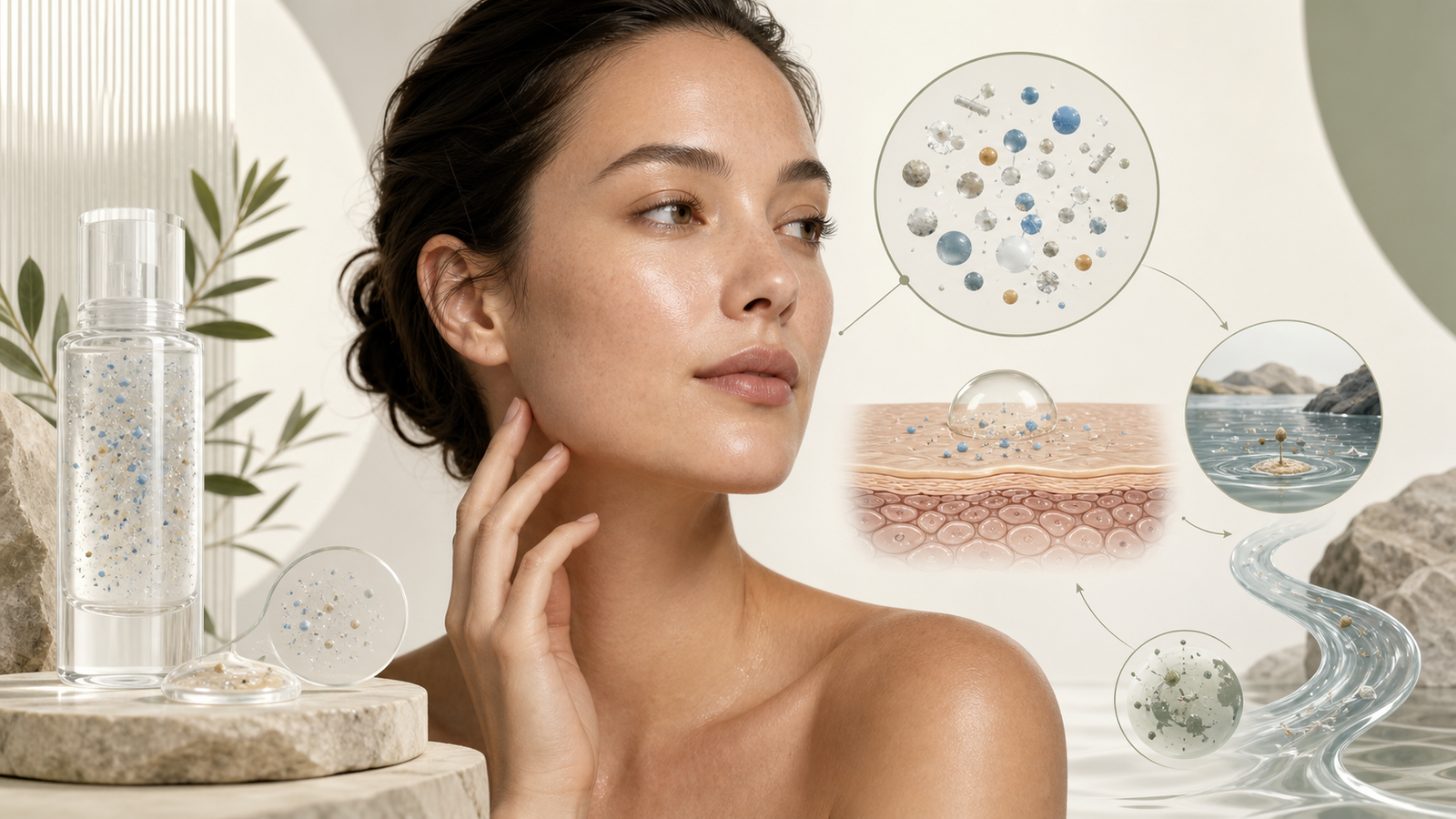
On 15 July 2026, the American Academy of Dermatology’s DermWorld Weekly included a question about plastics in personal care products and skin disease. That editorial signal mattered because it translated an environmental topic into a dermatology question readers are more likely to search directly. The item pointed to a new clinical review in the Journal of the American Academy of Dermatology. Available online on 20 April 2026, the review examines several related but different subjects: intentionally added plastic particles such as microbeads, microplastics and nanoplastics associated with packaging degradation, plastic-associated chemicals, and polymers used in formulas that may not be classified as plastics.
That separation matters. A face scrub containing visible plastic beads is not the same exposure question as a cream in a plastic airless pump. Neither is identical to a fragrance formula that may involve a plastic-associated chemical, or a serum that contains a soluble polymer for texture. When these categories collapse into one alarming headline, readers lose the ability to compare products or evidence intelligently.
The new review is useful because it puts dermatology, product formulation, packaging, and environmental pollution into one frame. It is also a clinical review, not a large trial proving that one routine causes one disease. Its abstract describes recommendations and impacts to examine; it does not provide a personal risk calculator. That distinction sets the tone for this guide: concern can be reasonable while the confidence of each claim remains limited by the underlying evidence.
First, define the material before judging the product
Microbeads are narrower than microplastics
The US Food and Drug Administration explains that the Microbead-Free Waters Act targets plastic microbeads in rinse-off cosmetics and certain non-prescription products because those particles are intentionally added for cleansing or exfoliation and then washed into wastewater. “Microbead” is therefore narrower than the broader microplastics discussion. That legal scope matters because many alarmist social posts flatten every synthetic polymer, package, and additive into the same category.
That law did not declare every synthetic ingredient in every cosmetic to be a microbead. It did not make “polymer” a synonym for danger. It also did not answer every question about leave-on products, packaging fragments, nanoplastics, or chemicals associated with plastic production. A reader who knows the scope can make a more accurate decision than someone working from a long online blacklist.
Particle size and physical form change the question
Microplastics are particles. Nanoplastics are smaller again, although scientific and regulatory size boundaries are not always identical. Physical form affects where material can travel, how it can be measured, and whether it is covered by a rule. The European Union’s legal language focuses on synthetic polymer microparticles that are solid and meet detailed dimensional and concentration criteria. It also includes exclusions for polymers with properties such as sufficient solubility or demonstrated degradability.
This is why an ingredient list can be informative without being a complete laboratory report. A label may name a polymer but not tell the reader whether it is liquid or solid in the finished formula, its particle size, its concentration, or how it behaves after use. Classification may require supplier documentation and analytical methods, not just a mobile screenshot.
Evidence-reading framework
Four Questions Before a Plastic Claim
A precise skincare decision starts by identifying what was measured and what the study can actually conclude.
What material?
Separate solid particles, soluble or liquid polymers, packaging material, and plastic-associated chemicals.
What evidence?
Distinguish a product survey, laboratory model, animal experiment, clinical observation, and human outcome study.
What exposure?
Consider rinse-off versus leave-on use, particle size, barrier condition, concentration, duration, and packaging contact.
What conclusion?
Detection proves presence in a sample. It does not by itself prove skin penetration, dose, or disease causation.
What current skin evidence can and cannot show
The 2025 review Microplastics in Cosmetics: Emerging Risks for Skin Health and the Environment summarizes potential mechanisms including barrier disruption, oxidative stress, and inflammation. It searched PubMed and Cochrane through 31 March 2025 and considered laboratory, animal, and clinical literature. Importantly, the authors also state that they did not conduct a formal risk-of-bias assessment. That limitation does not make the review useless; it tells readers not to treat all included evidence as equally strong.
Particle behavior may depend on size, shape, surface chemistry, concentration, and the condition of the barrier. A healthy stratum corneum is designed to limit penetration. Hair follicles, damaged skin, carrier ingredients, or very small particles may change experimental behavior. But a mechanism observed in a model is not the same as a measured rate of disease among people using a normal amount of moisturizer.
The 2026 JAAD clinical review also identifies measurement and long-term evidence gaps. Researchers must distinguish particles from the complex background of oils, emulsifiers, minerals, packaging, and environmental contamination. Methods differ, and very small particles are difficult to characterize consistently. As a result, confident consumer claims often run ahead of the available human dose-response evidence.
The responsible position is neither “there is no issue” nor “your cream is poisoning you.” Environmental persistence and avoidable release justify action. Potential dermal exposure deserves better study. At the same time, readers should not self-diagnose a rash as microplastic toxicity, discontinue medically important care, or assume that a single ingredient name predicts a health outcome.
What recent product testing adds
A 2026 study indexed by PubMed examined 79 selected personal care and cosmetic products from Türkiye, including shampoos, shower gels, peeling gels, and toothpastes. The researchers used stereomicroscopy and Nile Red fluorescence screening, followed by FTIR spectroscopy for confirmation. In their sample, shower gels contained the highest levels; no microplastics were detected in the toothpaste samples. They reported fibres most often in shower gels, followed by peeling gels and shampoos.
This is concrete evidence of detection in a defined sample. It is not evidence that the same percentages apply to every country, brand, batch, or product category. The number 79 describes the study sample, not the global market. The category findings can help researchers and formulators decide what to investigate next, but a consumer cannot use them to identify a particular bottle without product-specific data.
Detection also answers a different question from health effect. It shows that selected products contained material meeting the study’s analytical criteria. It does not establish how much remained on skin, how much entered tissue, whether the amount changed a clinical outcome, or whether packaging, manufacturing, or formulation was the dominant source. Good reporting keeps those questions separate.
Regulation is broader in some places, but definitions still matter
The United States focuses on rinse-off plastic microbeads
The FDA’s Microbead-Free Waters Act guidance explains that US law prohibits manufacturing, packaging, and distribution of rinse-off cosmetics containing plastic microbeads. The environmental pathway is straightforward: exfoliating beads are rinsed directly into wastewater. This was an important intervention, but it should not be described as a ban on every microplastic source or every synthetic polymer in personal care.
The European Union uses a detailed microparticle restriction
Commission Regulation (EU) 2023/2055 amended REACH to restrict intentionally added synthetic polymer microparticles. The legal text defines covered materials through physical and chemical criteria and includes exclusions, concentration rules, derogations, labeling obligations, and transition periods. ECHA’s consumer explanation notes familiar cosmetic uses such as exfoliation while also recognizing functions related to thickness, appearance, and stability.
Different timelines apply because reformulating a rinse-off microbead scrub is not identical to reformulating fragrance encapsulation, makeup, lip, or nail products. Regulatory precision may feel less satisfying than a universal “free from” promise, but it is more useful. It asks whether a material is persistent and particulate, whether alternatives exist, and what happens after release.
Why ingredient-list blacklists often fail
Skincare shoppers are frequently given lists of names to avoid. The appeal is obvious: a screenshot feels easier than polymer chemistry. The problem is that an ingredient’s name may not specify physical form in the finished product. It may not reveal molecular weight, solubility, degradability, concentration, particle dimensions, supplier grade, or the function that keeps the formula stable.
This is especially important for familiar texture and stability ingredients. Calling every silicone, acrylate, film former, thickener, or encapsulating polymer a microplastic can misclassify materials under regulatory definitions and encourage product swapping without reducing environmental release. It can also recreate the weak logic discussed in SKINEGA’s Free From Skincare Lists: the absence of one word becomes a marketing shortcut instead of evidence of a better full formula.
A stronger question for a brand is specific: Does this product contain intentionally added solid synthetic polymer microparticles under the relevant market definition? Are any particles used for exfoliation, texture, opacity, or encapsulation? Has the finished formula or raw material been assessed for particle form? What packaging components contact the formula, and what refill or recovery evidence supports the environmental claim?
A practical lower-plastic skincare routine
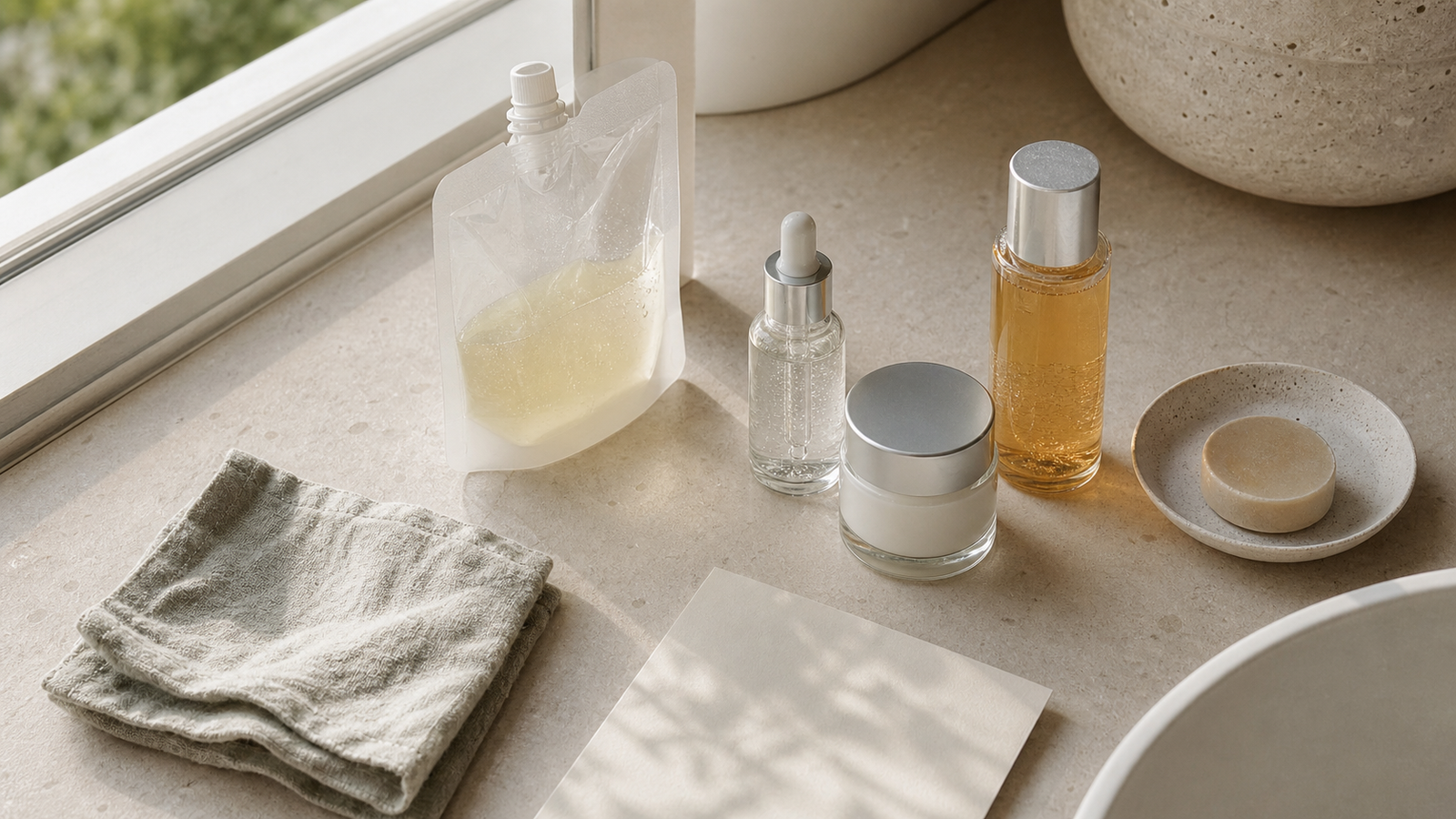
The most defensible first move is not a shopping spree. It is reducing duplication. If three serums address the same goal, the packaging and unused formula may matter more than a theoretical improvement gained by replacing all three with new “eco” versions. SKINEGA’s less-is-more skincare approach fits the environmental question because a shorter routine is easier to finish, evaluate, and repurchase deliberately.
Use what is suitable before replacing it
If a product is safe for you, used as directed, and not an obvious plastic microbead scrub, finishing it will often create less immediate waste than discarding it after a headline. A reaction is different: stop the product, document what happened, and seek qualified advice when symptoms are persistent, painful, swollen, blistering, or otherwise concerning. Environmental concern should not override basic product safety.
Compare systems, not just containers
Glass looks premium but is heavier to transport. Aluminum may be recyclable but still requires energy and compatible liners. A refill pouch can use less material but may be difficult to recycle locally. Pumps protect formulas but combine components. The best available option depends on product stability, local collection, refill logistics, shipping distance, and whether the user actually returns or reuses the pack.
Look for concrete disclosure: packaging weight, recycled content, separable components, refill reduction by mass, take-back locations, and what happens to returned material. “Ocean friendly,” “clean,” and “plastic conscious” are not measurements. This follows the same discipline as The Future of Clean Skincare: a broad claim should be supported by a clear standard.
Keep skin needs in the decision
Someone with reactive or over-processed skin should not replace a tolerated moisturizer with an irritating alternative simply because the new package looks greener. Barrier comfort, fragrance exposure, preservation, texture, and sunscreen use remain practical priorities. The skin barrier repair routine is a useful companion when the face is already stinging or peeling. Sustainability that triggers repeated product failure is not sustainable for the person or the waste stream.
How a premium consultation should handle the question
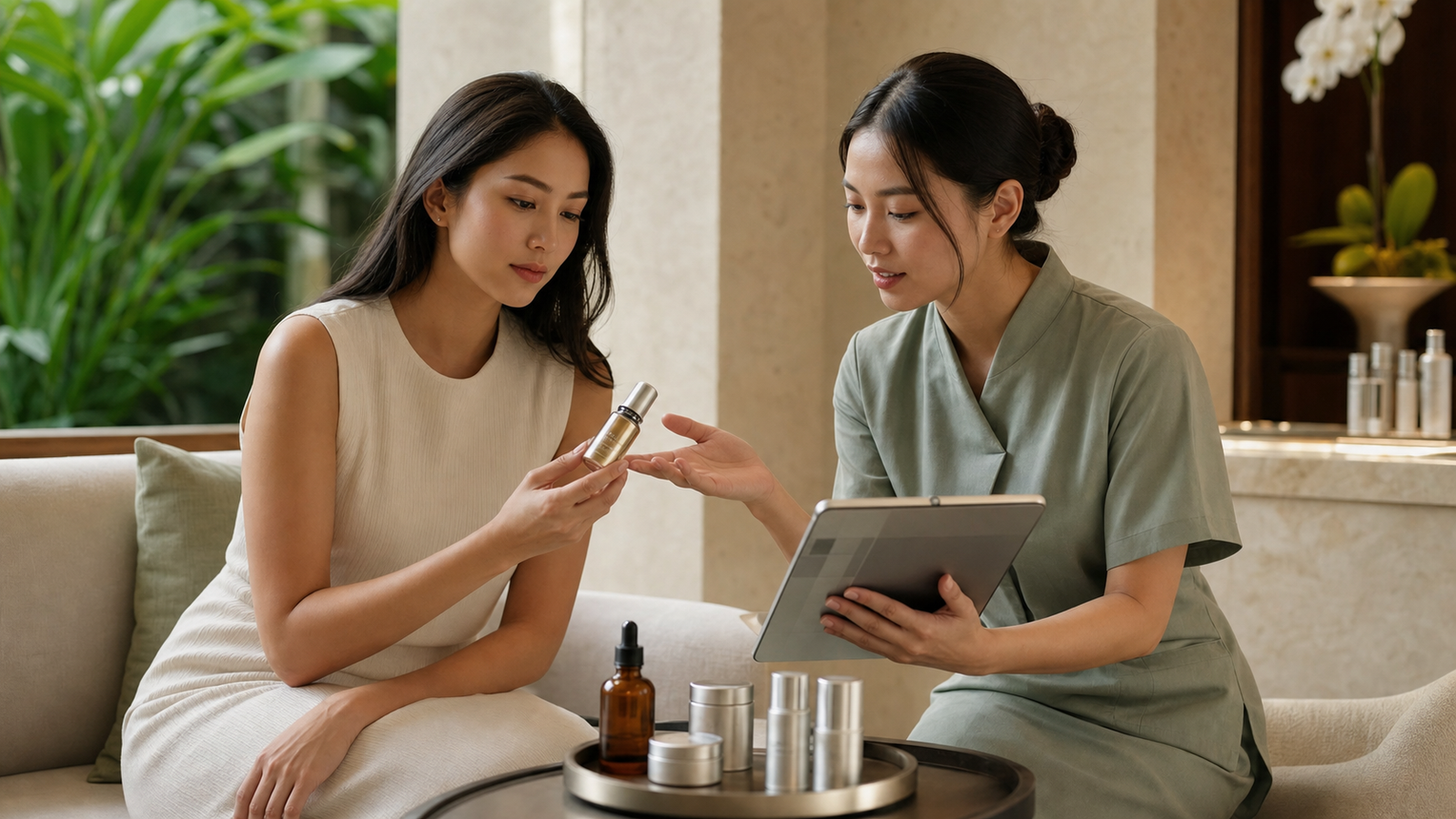
A skincare professional does not need to pretend to identify nanoparticles by reading a label. A credible consultation can instead separate three decisions. First: Is the product suitable for the client’s skin, goals, sensitivities, and current treatments? Second: Does the formula or brand provide meaningful information about intentionally added particles? Third: Is the packaging system credible in the client’s location and pattern of use?
For a premium facial studio, this can lead to simple operational improvements: avoid exfoliating products that rely on plastic microbeads, choose suppliers that answer technical questions, use measured quantities, prevent unnecessary single-use accessories, and explain aftercare without selling five overlapping items. These changes reduce avoidable material while preserving hygiene and treatment consistency.
What brands and formulators should disclose next
The research gap is not solved by replacing one marketing vocabulary with another. Brands can help by defining what they mean by microplastic, stating which jurisdiction or standard they use, identifying whether particles are intentionally added, and distinguishing formula content from packaging risk. If a product claims to be plastic-free, the scope should say whether that refers to formulation, primary pack, pump components, shipping materials, or all of them.
Testing methods also need to be described. Microscopy alone may screen particles but cannot always identify polymer chemistry. Spectroscopic confirmation can strengthen classification, while complex emulsions may make separation difficult. Quality control should account for airborne fibres and laboratory contamination. The 2026 product study’s use of microscopy, Nile Red screening, and FTIR illustrates why detection requires more than looking at a cream under ordinary magnification.
Finally, substitution should be assessed rather than assumed. A biodegradable or mineral alternative still needs safety, stability, performance, sourcing, and lifecycle evidence. The aim is not to remove a familiar ingredient name at any cost. It is to reduce persistent and avoidable release while maintaining a product that people can use correctly and finish.
A measured decision checklist
| Question | Useful evidence | Weak shortcut | Practical action |
|---|---|---|---|
| Does the formula contain particles? | Supplier data, physical-form criteria, analytical confirmation | An unfamiliar ingredient name alone | Ask the brand which definition and test it uses |
| Is there a skin-health risk? | Human exposure and outcome data at relevant doses | A mechanism observed only in a model | Keep claims cautious and report real reactions |
| Is the packaging better? | Material weight, refill reduction, collection and recovery data | Green color, glass appearance, or vague recycling icons | Choose a system you can finish and recover locally |
| Should the routine change? | Skin suitability, duplication, use rate, product lifespan | Throwing away everything immediately | Reduce overlap and replace deliberately |
Conclusion: precision is more useful than panic
Plastics in personal care products deserve attention because persistent particles can move from products and packaging into environmental systems, and because very small particles and associated chemicals raise legitimate research questions. Regulation in the United States and European Union already reflects part of that concern. Recent reviews and product testing add detail, but they do not turn every polymer into a microplastic or prove that a normal skincare routine causes skin disease.
The most useful response is disciplined: understand the material, ask what was measured, protect the skin barrier, avoid obvious microbead exfoliants, reduce duplicate products, compare packaging with real data, and reward brands that disclose definitions and evidence. A premium routine is not the one with the loudest purity claim. It is the one whose formula, packaging, use, and afterlife can be explained without hiding uncertainty.
Frequently asked questions
Are microplastics present in every skincare product?
No. Product categories, formulas, markets, dates, and legal definitions differ. Some products may contain intentionally added solid polymer particles, some may be exposed to particles through manufacturing or packaging, and many will not fit either description. A study of selected products cannot establish that every cleanser, cream, or serum contains microplastics. Ingredient lists can support questions, but they do not always reveal particle size, physical form, concentration, or whether a named polymer falls inside a particular regulatory definition.
Can microplastics pass through the skin barrier?
Experimental research suggests that particle size, surface chemistry, carrier ingredients, hair follicles, and barrier condition may affect penetration. That does not mean ordinary use of a cosmetic has been shown to cause disease in people. Much of the current discussion relies on laboratory models, animal evidence, exposure studies, and reviews. Human dose-response data and long-term real-world measurements remain limited, so the responsible conclusion is that dermal exposure deserves research rather than that harm is guaranteed.
Is every synthetic polymer on an ingredient list a microplastic?
No. “Polymer” is a broad chemical category, while microplastic rules generally depend on properties such as whether a material is solid, particulate, synthetic, persistent, and within defined size or concentration ranges. Soluble, liquid, degradable, natural, or non-particulate polymers may fall outside a given definition. An ingredient name alone is therefore not enough to classify a product confidently. Avoiding every unfamiliar polymer can also remove useful texture, stability, or delivery functions without answering the environmental question accurately.
Should I throw away skincare products I already own?
Usually not on the basis of a headline alone. Discarding a suitable product creates immediate waste and may destabilize a routine that is working. A more practical approach is to finish safe products as directed, avoid obvious plastic microbead scrubs, reduce duplicate purchases, compare packaging when replacing an item, and ask brands specific questions about solid polymer particles, refill systems, and material recovery. Stop using a product if it causes a reaction and seek qualified advice for persistent symptoms.
What is the most useful first step toward a lower-plastic skincare routine?
Reduce the number of products that do the same job. A short routine with a cleanser suited to the skin, a useful moisturizer or serum, and appropriate sun protection is easier to finish and easier to evaluate. At replacement time, compare concentrated or refillable formats, packaging weight, component separability, and brand disclosure. No package is impact-free, so consistency, product suitability, and verified information matter more than a vague “plastic-free” slogan.
Main sources
- American Academy of Dermatology - DermWorld Weekly
- Journal of the American Academy of Dermatology - Plastic in dermatology clinical review
- US FDA - Microbead-Free Waters Act FAQs
- European Chemicals Agency - Microplastics restriction
- EUR-Lex - Commission Regulation (EU) 2023/2055
- PubMed - From Shelf to Skin study of 79 products in Türkiye
- Cosmetics - Microplastics in Cosmetics review